sat suite question viewer
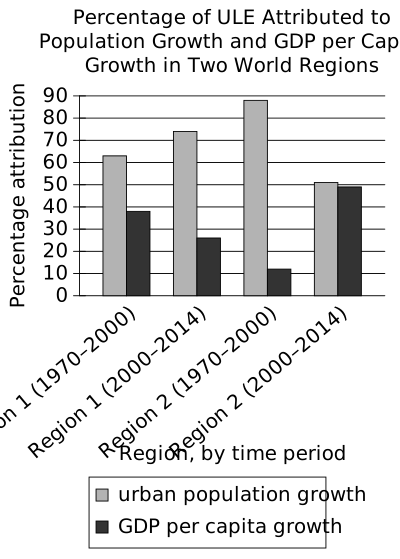
- For each data category, the following bars are shown:
- urban population growth
- GDP per capita growth
- The Percentage attribution data for the 4 categories are as follows:
- Region 1 (1970–2000):
- urban population growth: 63%
- GDP per capita growth: 38%
- Region 1 (2000–2014):
- urban population growth: 74%
- GDP per capita growth: 26%
- Region 2 (1970–2000):
- urban population growth: 88%
- GDP per capita growth: 12%
- Region 2 (2000–2014):
- urban population growth: 51%
- GDP per capita growth: 49%
- Region 1 (1970–2000):
In a study of urban physical expansion, Richa Mahtta et al. conducted a meta-analysis of more than 300 cities worldwide to determine whether urban land expansion (ULE) was more strongly influenced by urban population growth or by growth in gross domestic product (GDP) per capita, a measure of economic activity. Because efficient national government is necessary to provide urban services and infrastructure that attract economic investment, Mahtta et al. propose that absent other factors, the importance of GDP per capita growth to ULE would likely increase relative to the importance of population growth as governments become more efficient. If true, this suggests the possibility that blank
Which choice most effectively uses data from the graph to complete the statement?
Explanation
Choice A is the best answer because it most effectively uses data from the graph to complete the statement about Mahtta et al.’s proposal regarding factors that affect urban land expansion (ULE). According to the text, ULE is influenced by urban population growth and by gross domestic product (GDP) growth per capita. Reasoning that efficient national governments provide urban services and infrastructure needed to attract economic investment, Mahtta et al. suggest that, as governments become more efficient at providing urban services and infrastructure, GDP growth per capita will account for more ULE and urban population growth will account for less. But according to the graph, Region 1 saw an increase in the percentage attributed to urban population growth from 1970–2000 (between 60 and 65%) to 2000–2014 (between 70 and 75%) and a decrease in the percentage attributed to GDP growth per capita from 1970–2000 (between 35 and 40%) to 2000–2014 (about 25%). Because the percentage attributed to GDP growth per capita decreased (the opposite of what Mahtta et al. claimed would happen if the governments had become more efficient), the data suggest that the governments of Region 1 became less efficient at providing urban services and infrastructure over that period.
Choice B is incorrect. Neither the graph nor the text gives the regions’ relative levels of economic growth or what effect Mahtta et al. would expect such growth to have. Furthermore, Mahtta et al.’s proposal suggests that Region 1’s decline in the percentage of ULE attributed to GDP growth per capita from 1970–2000 (between 35 and 40%) to 2000–2014 (about 25%) would suggest decreasing, not increasing, government efficiency over this time. Choice C is incorrect. Neither the text nor the graph provides information about the relative efficiencies of different governments in Region 2. Choice D is incorrect. Mahtta et al.’s proposal suggests that more efficient governments will have a higher percentage of their ULE driven by GDP growth per capita and a lower percentage driven by urban population growth. For Region 2, the percentage of ULE attributed to GDP growth per capita increased from 1970–2000 (between 10 and 15%) to 2000–2014 (between 45 and 50%), but the opposite is true for Region 1, which saw the percentage of ULE attributed to GDP growth per capita decline over the same period. Thus, whereas the data suggest governments in Region 2 became more efficient, the data for Region 1 suggest that those governments became less efficient, not more.